admin

The Never-ending Nightmare of The Prisoner Video Game

By Dylan • 5 March 2021

Hello all and welcome to the final part of my three part series on the Prisoner video game. If you missed the first part where I outline what the video game is and tackle some of the apocrypha surrounding it, be sure to check it out here. In the second part I recounted a play through of the video game from my point of view, you can check that out over here. In this part I’m going to wrap up some final thoughts relating to the video game and its relationship with the television show upon which it is ostensibly based.

Remember how at the end of part 2 I said if everything went right I would have escaped the Island by now? Well, I did not. I failed. Miserably. I didn’t actually figure it out on my own, but to be fair the estimate is that The Prisoner is a 60 hour video game and I gave it less than half of that. I’m a busy man you see, I’ve got two podcasts a week to edit. Speaking of which, as of this post we’ll have started our podcast on The Prisoner (2009) so go ahead and go give it a listen, I’m exceedingly excited to see where it goes this season. But beyond just playing it, let me talk a little about some conclusions I have about The Prisoner, how successful (or not) it is at being a Prisoner adaptation, and doing a little meta fiction dive.
But let us return to a question I asked in the first part of this blog series. Is The Prisoner the first Meta fictional Video Game? And the answer to that is, I’m fairly certain, yes. I could find no evidence in any of my research that any game before this one did a lot of the things that this one does in the vein of exploiting the meta fiction of the medium. The first Metal Gear, probably the next closest I could think of, wasn’t published until 1987, a full 6 years after the first version of The Prisoner.

And we should talk about that, because you may be surprised to learn that by the writing of this article, The Prisoner is not listed on the Wikipedia list of “Metafictional video games.” Which is a bit of a shocker because it really does delve into some really really trippy things. I’ve already talked about the one, in my very first blog post. In that post I mention that some versions of Prisoner 2 will fake a crash on a line number corresponding to your reason for resigning in an attempt to get you to input your reason for resigning into the crash window. Devious, I know. But think about that for a second. This is something that wouldn’t work in any other medium. A Prisoner book can’t just fake a crash. You can’t even interact with a Prisoner book in the same way. The Prisoner video game exploits the fact that it is a video game in order to defeat you. It would be like if the opponent king on a chess board decided to start jumping up and down to try shake the board enough to tip your king over (tipping your king is a resignation in chess), thus exploiting the physical nature of your chess game to defeat you outside the prescribed rules of the games.

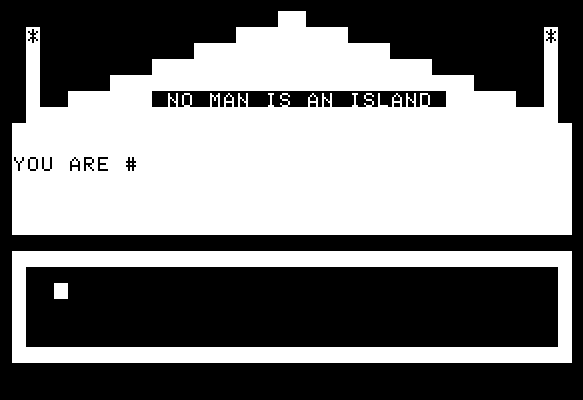
This kind of gameplay, I would argue, makes The Prisoner one of the most immersive video games ever created, even 40 years after publication. The game is directly playing against you, and is devious enough to use that fact against you. Or even consider the town hall segment of the game where you are tasked with managing the Island’s resources as if you were #2. If you decrease surveillance below 100% you start to lose information. Maybe now you only know how much water we have on the Island every 10 seconds instead of every 1. Maybe you can’t tell if someone’s trying to escape and has killed one of your guards, so your guard number is no longer updating. It cunningly puts you in #’s shoes, forcing you to make the decisions as he would, with the same information. Which is really what the game is all about, lest we forget that the game is simply trying to get you to input a random three number string that it gives you at the start of the game. Obviously the game knows what the string is, it generated it for you, but that’s not the point. You become so thoroughly convinced that that #2 in the game is trying to get you that you guard that number like it’s your life. I know I did. Many times. Whenever I would get stuck though, in a puzzle I couldn’t defeat, or as in my last post an infinite loop I could not escape, I would input the code and try again from the top.
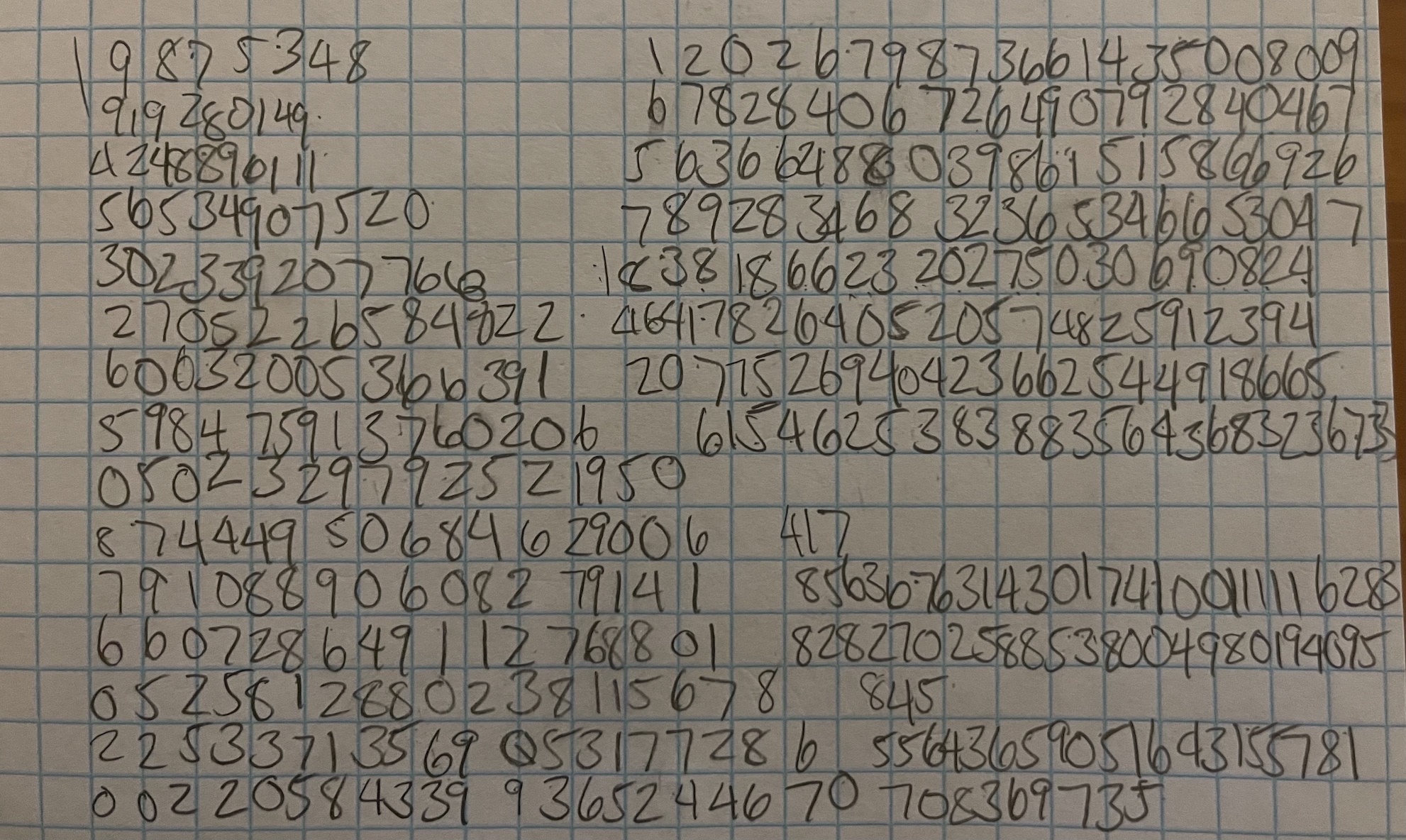
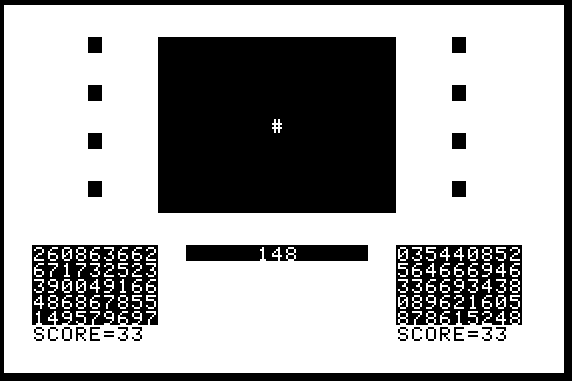
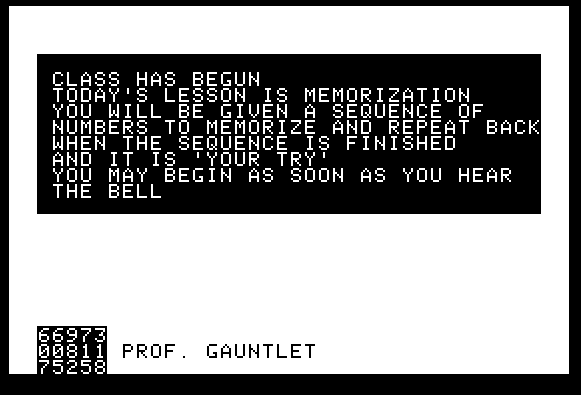
If there was one criticism I could level at the game, it’s that some of the minigames are just ridiculously overlong. For example, the schoolhouse. In the schoolhouse you’re presented a memory challenge, where you have to remember a sequence of numbers that appear on screen and then input them back. Each time you get it correct the length of the sequence increases by one. It decreases if you get a digit wrong, and your goal is to get up to.. I don’t know. I gave up at 30 digits long, and that alone took me well over 35 minutes to get to that point. It’s really slow because you have to wait for each digit to display before you can put the next. It’s horribly contrived and by 10 digits long I was writing down the sequences to make sure I wouldn’t make any mistakes. And then if you did make a mistake you still had to enter the required number of digits before the game would proceed. There were oft times at 20 digits I would mess up digit 4 and sit there spamming the 1 key until it gave me a new sequence. It does try to trick you at 25, where it gives you a three digit sequence that’s your retirement reason, but then it pops up to 26 when you put in some other random string of numbers (which I did). I mean, I get the desire to make the player really feel beat down like 6 was, but at the same time I just don’t have an hour to dedicate to inputting numbers into a computer game.

Which actually brings me to what I wanted to talk about, which is that The Prisoner is a really interesting video game adaptation of a visual property because it doesn’t ever directly adapt anything from the TV show. Sure the leader of the island lives in house number 2 and you live in house 6 and there are other suitably subtle but equally as interesting references to the television show that a well versed fan will pick up on. But you’re never actually playing as Patrick McGoohan, or Leo McKern for example. You don’t even live in The Village, it’s the Island. And yet somehow the game feels like the most faithful adaptation of a popular property that I’ve ever played.

I think the reason for that is the incredible job that The Prisoner does in adapting the feeling rather than the content of the product its adapting. Batman: Arkham Asylum is an equally successful adaptation because instead of trying to adapt a specific Batman story they made a game that focuses on giving you the feeling of playing as Batman.

One of the most successful elements of the game is the lingering paranoia that it imbues you with. Like the sequence of memorization above, every time a new sequence comes up you’re not just focused on memorizing it to get it right, there’s always a lingering thought in the back of your mind, checking every three digit string trying to see if it has your resignation in it. And that just makes it harder to memorize which makes it harder to progress so you get frustrated so you stop paying so much attention to whether or not your resignation appears in the sequence.

For some reason you’re always aware of being watched in the game. Just like how #6 is being watched for the entirety of his stay. But the comparisons go deeper. #6 is aware of his surveillance, and uses it against #2 (see Hammer into Anvil). And #2 in reciprocation is aware that #6 knows and uses that information against him. Now play The Prisoner. The video game is completely aware that you’re playing a video game and it uses that against you! Not just in the now famous fake crash. On occasion the game will recognize and admit that you’re playing a video game. Weren’t paranoid before? Now you are. Now the game recognizes you’re playing it just as much as it’s playing you. If that doesn’t drive you to the breaking point what will?

There’s a really bizarre sense of unease in knowing that the game is blending into the real world. You start to feel like there isn’t really a division anymore between the game and your real life anymore. When the game starts to mimic OS functions the line between “the game” and “not the game” blurs, disappearing almost completely. This is where I think The Prisoner exceeds expectations when it comes to metafictional video games. It reaches levels beyond that of many other video games by turning your entire computer into a potential battlefield. Just like when #6 is in the village, you can never let your guard down. You insist over and over that you’re a free man, but at the end of the day you lie down defeated, knowing that you’re not. Because you’re always wondering if the game is still trying to find out why you resigned. Which, by the way, why did you resign?
Posted by admin in Blog, 0 comments

The Prisoner (2009) 1 – Arrival

The Prisoner Returns!

This is probably the most divisive show that we’ve done for Inevitable. Our fans have given us various opinions, from bad to great to love to dishonor on the Prisoner’s family. And yet here we are, forging forth and doing it anyway. Because 1) we want to and 2) it’s best to make your own opinions. It’s Arrival, written by Bill Gallagher and released on November 15, 2009.


Show-notes:
1:25: You can find our new blog here. We planned on updating once a week at first, but we realized we couldn’t keep that up with how busy we are lol. We have two Prisoner posts up so far. The first is an introduction to the 1980 Prisoner video game and the second is a playthrough of it.
8:00: Our previous season on The Prisoner (1967) starts with Episode 1 – Arrival as well.
8:10: You can find the Could it Have Been Worse? article on the Unmutual Prisoner Archive.
12:26: If you want to listen to us talk way too much about Doctor Who for some reason, check out our Doctor Who podcast Trust Your Doctor: A Doctor Who Podcast. Also the name of the the city where this series was filmed is Swakopmund.
15:00: Buy your own copy of the Prisoner miniseries.
18:02: Pop Apostle’s page on this episode.
19:15: Here’s an example page from the AMC blog index, as well as one of the production notes that I referenced.
44:10: Here is the Wikipedia page for On Exactitude in Science as well as an online copy of the story in both its original Spanish and an English translation. Also, it was Baudrillard who touched on this story.
51:26: Do Not Forsake Me Oh My Darling
1:10: Here’s our episode on A, B, and C with Keith as a guest in our first season on The Prisoner. We talk about technology that was sci-fi in the 60s but real now.
1:05:30: If you want to hear us talk about an actual PJ Hammond episode, check out our episodes on Sapphire and Steel, like this one, the first episode.
1:13:03: And if you want to listen to us talk about movie trilogies for whatever reason, check out Triple Play: A Movie Trilogy Podcast, our movie trilogy podcast.
1:25:48: If you want to listen to a great Doctor Who podcast that covers Classic Who episodes in “excruciating detail” (their words, not mine), check out Krynoid Podcast.


The Prisoner © ATV
Any other references belong to their respective owners, no copyright infringement is intended by this podcast.

Subscribe on Apple Podcasts!
Subscribe on Google Play!
Subscribe on Spotify!
Check us out on Facebook!
Check us out on YouTube!
Check us out on Twitter!

Posted by admin in Inevitable, 0 comments

336: They Keep Killing The Spinoffs (Escape to LA)

Damn we can never get any Doctor Who spinoffs can we?

This week on K9 and Company. Wait no wrong spinoff. This week on Class… Sarah Jane Adventures… The Prisoner… Hang on just bear with me I’m going to get there eventually. Oh Torchwood, that’s right Torchwood: Children of Earth. Dammit. It’s Escape to LA, written by  Jim Gray and John Shiban and aired on July 29, 2011.


Show-notes:
46:39: More on car crushers I guess.


Torchwood © The BBC
Any other references belong to their respective owners, no copyright infringement is intended by this podcast.
The Torchwood title music was originally composed by Murray Gold. The version used in this episode was arranged by Murray Gold.

Subscribe on Apple Podcasts!
Subscribe on Google Play!
Subscribe on Spotify!
Check us out on Facebook!
Check us out on YouTube!
Check us out on Twitter!


Posted by admin in Trust Your Doctor, 0 comments

335: Confusing Confluence of Culinary Ideas (Dead of Night)

Honestly this title alone was confusing.

We record these podcast in the dead of night now actually. Like way late at night. Like 7 PM. I know, so late right. In the UK the sun is probably still up at that time, being all a million miles from the equator and all that, but down here thanks to the end of DST we’re solidly two hours into darkness at that point. Yeah sun goes down at 5. Well 5:30 now but you get the point. It’s Dead of Night, written by Jane Espensen and aired on July 22, 2011.


Show-notes:
3:04: Check out our classic sci-fi podcast, Inevitable: A Classic Sci-fi Podcast.
13:38: Speaking of blog posts, we have a blog now that you can and should definitely check out.
17:50: Inferno the movie, not Inferno the Doctor Who story.
24:12: Here’s our blog post on Torchwood Children of Earth and the “Steven Moffat Effect”
30:16: November 23 on the tardis wiki
50:00: Here’s “Embrace Lung Cancer,” our episode on the book Mad Dogs and Englishmen.
52:43: Skip Schoolink on imdb
53:01: His full name is Rostam Batmanglij.
1:07:00: Check out our movie trilogy podcast, Triple Play: A Movie Trilogy Podcast.
1:11:10: Here’s our blog post on Revolution of the Daleks and Ryan and Graham’s departure.


Torchwood © The BBC
Any other references belong to their respective owners, no copyright infringement is intended by this podcast.
The Torchwood title music was originally composed by Murray Gold. The version used in this episode was arranged by Murray Gold.

Subscribe on Apple Podcasts!
Subscribe on Google Play!
Subscribe on Spotify!
Check us out on Facebook!
Check us out on YouTube!
Check us out on Twitter!


Posted by admin in Trust Your Doctor, 0 comments

An Embarrassingly Bad And Somewhat Disappointing Play Through of The Prisoner Video Game

By Dylan • 19 February 2021

Hello all and welcome back to my three part series on the Prisoner video game. If you missed the first part where I outline what the video game is and tackle some of the apocrypha surrounding it, be sure to check it out here. To give a brief recap, The Prisoner was released in 1980 for the Apple II by Edu-Ware. The first version of the game (the one that I played) is a top down text adventure, whereas the second edition was a full color first person version.

In this part I will outline some of the things you might expect were you to boot up the game yourself. Obviously I won’t spoil everything, I wasn’t even able to finish the game in the time I dedicated to it over the past two weeks, and this blog post serves largely to outline my first play through of the game. Two weeks from now in the third part I’ll give a retrospective on my time in game, doing a deeper dive into the metafictional aspects of the game and how they relate to the series as a whole, so stay tuned for that.

The game loads, my ears bleed from the chiptune emulated soundtrack, and for this run through the reason I’ve been given for my resignation is [redacted]. You didn’t think that I would just give that to you, did I? What if this blog is part of the video game? No way man, I won’t risk it. Just know that it was a three digit number. That’s all you need to know. The first challenge is a maze, with the least intuitive controls ever. You might think “well WASD isn’t so unintuitive, it’s just up down left right but in the middle of the keyboard,” and you wouldn’t be wrong. But the control scheme was actually UDLR, for up down left right. Makes perfect sense, but is also incredibly inconvenient to use on the keyboard. Like really inconvenient. At the end of the maze is your first possible failure point. The game inquires as to your name and gives you 5 options. The first 4 are random symbols, the 5th is your reason for resigning. As I said in my first blog post, your name in the game is #, and you must correctly self identify here to proceed. Accidentally giving your name as your reason for resigning fails you instantly!

Once you pass this challenge you’re informed that the caretaker wishes to see you. The control scheme now switches to, well, NSEW. Each key corresponds to a cardinal direction, North, South, East and West. Easy right? Intuitive, three of the keys are right next to each other, it’s generally an “alright” control scheme.

From here you can go where you please, do what you want, you just have to try and fulfill the two primary goals of the game:

  1. Escape.
  2. Don’t reveal why you resigned.

By the way it should be noted here that I’m not kidding when I say that the soundtrack is ear bleed inducing. The failure noise is an ungodly mess of high pitched tones that form a sort of aural cacophony that just absolutely annihilates your ear drums. If #6 had been subject to this noise on the show I have absolutely no doubt in my mind that he would have given in Day 1. Not to mention the loading noise, which is just a random tone at a random point in the scale played at each half a second interval as the game loads. How did people play games in the 80s? I would never have survived.

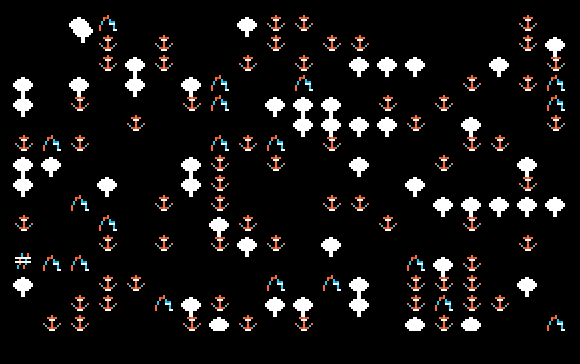
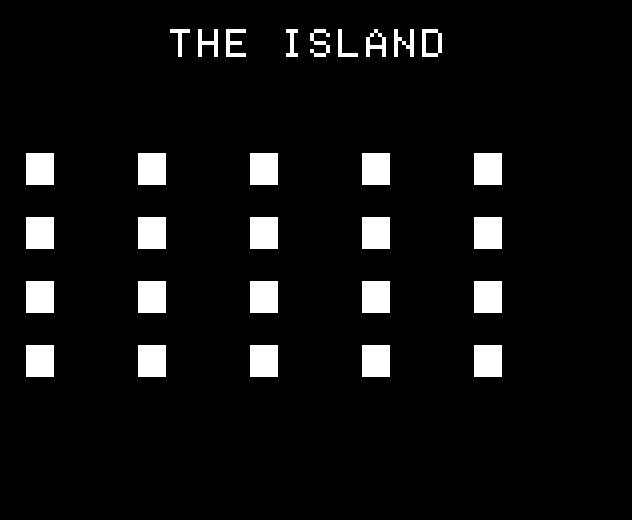
I explored the first few little houses, encountering the news stand, the library and the bank. The library did not allow me entrance unless I had something to contribute. The newsstand only sold The Islander (remember that in the game The Village is replaced by The Island) and the bank didn’t allow me to deposit or withdraw anything without my bank code. I had a suspicion that if I input my reason for resigning here into the bank, I would fail, and the same at the news stand when they asked what paper I would like. I did find out that the bank would accept a black tie as a loan. Weird. I went off east to another screen of four identical houses and this was about the time I realized that it would be really helpful if I had a damn map. I would find a map later, only to discover it looked like this:

Useful.

After some wandering I came to the hospital, where there’s a particularly ruthless test of memory and patience. You are presented with a continuous sequence of letters, numbers and symbols, and you are asked to… actually you’re not asked to do anything. This is a running theme throughout the game; absolutely no directions are ever given to you at any point. You’re left to discover how each minigame works through your own methods and experimentation. Through some experimentation I found that pushing the first symbol in each sequence progressed me to a new frame, before nearly getting tricked halfway through the game. For three consecutive frames the first three symbols were numbers that had I complied would have given away my reason for resigning! Later I discovered that in actuality you wanted to push the key of one of the symbols that had changes between frames, and not always just the first one. It just happens that the first symbol almost always changes.

I found the caretaker in house 2 (a sly reference to the show) where you are able to have a conversation with him. Responding to “I am the caretaker for the master” with “Who is the master?” receives the response “You are #.” It’s like I was playing out the intro to the show for myself! Thrilling! Asking him for help or giving him a response he does not understand leads to him booting you from the house. Oops.

In the center of each map was a white square which upon interaction turned into an information board. Here I discovered that my bank account number was 71521 and that I had 499 credits to my name. I used 5 credits to purchase a black tie and was met with the response that “I could bank on that selection.” The game is funny and smart! What more could you want!

I eventually discovered that the map is looping, so going too high north or too far west for example just looped around to the other end. One day while roaming I returned to the library having since purchased a book at the general store, which lead to the library administering me a personality test in which I had to select between two different books repeatedly. After that it knocked me out, returning me to my home where the next day I discovered that every door on the Island was locked.

I was distressed, disturbed even. Had I broken the game? Evidently not, as I eventually stumbled upon an infinite field of 2-dimensional flowers. I roamed there for an hour. Literally, an hour, before going to bed and returning the next day, at which point I stumbled upon a train station that took me to the city. It was here that I made my way to the company, where the general asked me to tell them why I resigned. I refused, the events of Many Happy Returns playing themselves over in my mind. He threw me behind bars. In much the same way Patrick McGoohan ended each episode behind bars, so too was I know behind bars. Sure my bars were embedded in the computer screen, and whoever was on the other side was really just a rudimentary AI coded in 1981, but the feeling was the same. If I pushed a key I would be taken back to the general, where I would refuse to give up my reasons. I was stuck in another devious loop puzzle, much like the endless fields of flowers, designed to drive me mad and give in. But there had to be way out…

…and that was where I got stuck. I had no idea how to proceed and didn’t want to tell them why I resigned. Not now, not yet, I was still so green behind the ears in my experience! But… I gave up eventually. The Prisoner had beaten me, for now. My playthrough had been going quite well until that point. I had received a gold watch from managing the Island in my turn at Free For All. I’d purchased a clone suit and was going to make my way to the Gemini Diner for my turn at Schizoid Man. Alas though, the Island had to resort to none too clever schemes. No, it was Chimes of Big Ben that took me down in the end. For now. I conceded and told “The Company” why I resigned. And then I lost and was treated to a headache inducing chorus of disapproving chiptune chimes. Ouch.

My final score was 33. Rest assured though that I did not stop there. I’m in the midst of a decidedly more successful playthrough where I have endeavored to avoid the company of The Company as long as possible. Perhaps we’ll meet again, perhaps not. Stay tuned to see how this exciting adventure ends in part 3, where if everything goes right I’ll have passed the game and escaped The Island successfully.


Were you disappointed in my play through of The Prisoner? Do you have faith that I’ll find my way off The Island before the third installment of this series? Pick up the red phone and send us a message on Twitter or Facebook to let us know.

Posted by admin in Blog, 0 comments

334: Different Hairstyle, Same Fists (Rendition)

I usually prefer to keep my hairstyle the same and change up my fists, but maybe that’s just me.

This new rendition of Torchwood continues to amaze and astound. This week, we’re off to the land of the free and the home of the brave. But first, the Torchwood team (i.e. Gwen and Jack) have to deal with some snakes (noun; a treacherous or deceitful person) on a plane. It’s Rendition, written by Doris Egan and aired on July 15, 2011.


Show-notes:
0:55: Check out our other podcasts, Inevitable: A Classic Sci-Fi Podcast and Zenith: A Blake’s 7 Podcast.
4:13: Imagine being one of the people who got a car on Oprah. Imagine.
4:34: Bees!
13:05: Check out Delayed Replay, a podcast that reviews movies that definitely weren’t delayed by the pandemic and definitely came out.
40:00: Will I ever have to stop linking the Gonna Score Tonight song from Grease 2? The world may never know.
1:04:40: Yes, MI5 is domestic and MI6 is international.
1:04:40: I actually looked for like half an hour for this quote and couldn’t find it at all.
1:25:17: Here’s our first blog post on the Apple II Prisoner game from 1980.


Torchwood © The BBC
Any other references belong to their respective owners, no copyright infringement is intended by this podcast.
The Torchwood title music was originally composed by Murray Gold. The version used in this episode was arranged by Murray Gold.

Subscribe on Apple Podcasts!
Subscribe on Google Play!
Subscribe on Spotify!
Check us out on Facebook!
Check us out on YouTube!
Check us out on Twitter!


Posted by admin in Trust Your Doctor, 0 comments

333: When the Starz Align (The New World)

Sometimes, when the stars align, you get a fourth season of Torchwood. This is that season.

We enter the final season of Torchwood, and the podcast is coming to a close. Of an era. Close of an era. Haha almost had you going there for a second didn’t I? You were worried for a hot a second right? Ha ha. Ha. It’s The New World, written by Russell T. Davies and aired on July 8, 2011.


Show-notes:
2:12: Thank you TARDIS Wiki for prominently displaying this disembodied head on your page for Miracle Day.
15:47: It was The Subprimes by Karl Taro Greenfield.
46:24: If you want to listen to us discuss The Prisoner and other sci-fi shows that aren’t Doctor Who, check out our classic sci-fi podcast, Inevitable A Classic Sci-Fi Podcast. We also just published this blog post about the Prisoner Apple II game from 1980.
51:00: The Fourth Doctor’s era lasted from 1974 to 1981.
1:08:42: And if you want to listen to us talk about movie trilogies for some reason, check out our movie trilogy podcast, Triple Play: A Movie Trilogy Podcast.

[/expand]

Torchwood © The BBC
Any other references belong to their respective owners, no copyright infringement is intended by this podcast.
The Torchwood title music was originally composed by Murray Gold. The version used in this episode was arranged by Murray Gold.

Subscribe on Apple Podcasts!
Subscribe on Google Play!
Subscribe on Spotify!
Check us out on Facebook!
Check us out on YouTube!
Check us out on Twitter!


Posted by admin in Trust Your Doctor, 0 comments

What is The Prisoner Video Game?

By Dylan • 5 February 2021
 

Did you know that there’s a Prisoner video game? Neither did I until the last episode of our Prisoner run through on Inevitable: A Classic Sci-Fi Podcast. Originally Kiyan and I had slated to talk about this video game during the second Prisoner season, but then we started a blog and it became evident that this would be the perfect topic for a blog post.

This week’s post is the first in what I plan to be (should everything go well) a three part series leading into our fifth season of Inevitable where we cover the Prisoner miniseries that aired on AMC. The first post (this one) will serve as an introduction to the video game, the second will concentrate on my experience with the game and the third will be a conclusion post and discussion on certain elements that I feel warrant further discussion.

The title screen of The Prisoner for Apple II

The Prisoner video game (which I will just refer to as The Prisoner from here on out) was released in 1980 for the Apple II by a company called Edu-Ware. Yes, that Apple II. Two years later Edu-Ware remade the game in full color with first person graphics. Yes, they turned an overhead game into a first person game. Weird. I know. For all intents and purposes though it’s the same game, but I prefer the text-adventure stylings of the first game. And, much to my disappointment, Edu-Ware was bought out in 1984 and slowly vanished in the next year. How sad.

The Prisoner is pretty difficult to play in [current year]. For legal reasons I shouldn’t tell you how to play it but I can tell you that a copy of the game may or may not be on mybandonware.com and that there may or may not be a javascript Apple II emulator online and that to play you probably need to type “RUN PR” after pointing it to the requested floppy disk image. All of this is alleged, you understand. Prisoner 2, the color remake, can be played freely on the Internet Archive as part of their effort to catalog early computer programs and games, specifically those for the Apple II. The Prisoner has not been updated or rereleased on any new platforms since its original release, although other adaptations of the television show exist in other mediums. That makes the video game particularly unique as far as adaptations go.

Upon startup I was immediately struck by the bizarre metafictional aspect of the video game, and so sprung forth what seemed to be a bizarre blog post in waiting. We’ve seen a lot of metafictional video games recently, things like There is No Game, Pony Island, or The Stanley Parable, for example. Hell, Kiyan has a whole blog with posts just on the weird shit that the Metal Gear franchise does. But while playing I had a question. Was The Prisoner the first metafictional video game? This is the question I seek to explore over the course of this series.

Resignation code screen in The Prisoner

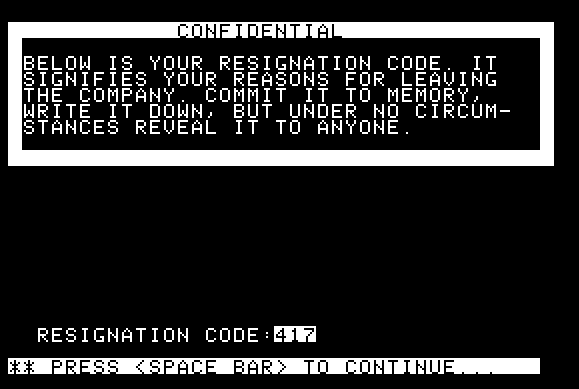
Which, let’s get this in here as early as possible. The Prisoner is weird. And I mean weird. How else are you going to adapt the most contemplative, allegorical, mildly science-fiction tilted television show pre-1980? I’m mildly convinced that this video game could pass the Turing test. Like a game of chess, you play against the video game itself. Upon startup you’re given a three digit number. This number is the reason you, the player, resigned from whatever you want. You make a choice on where to fly (I chose London, but Paris was tempting) and immediately get knocked out and taken to The Island (changed from The Village). For the rest of the game you have to do everything in your power to escape without giving the game your reason for resigning.

The game itself is the Village. Things will pop up, minigames will happen where questions are posed, tricks are employed, and just generally the game tries to outsmart you to get you to input your reason for resigning. Because of this I went in trying to avoid knowing anything about the tricks that the game was about to play on me. But I will first provide the sole example I knew before going in, perhaps the most meta of them all.

At some points the game will fake a crash. Yes, that’s right, the game will pretend to crash on a random line that happens to be your secret reason for resigning. On the Apple II you would, as I learned, input a command to view this line to see what caused the crash. By putting in your line number here you lose the game, because this was a fake crash and the game was still running. Checkmate.

So I went into this experience with only this knowledge and no more. And man was The Prisoner a wild playthrough. I didn’t even know how to get out of The Island, if there even was a way, and so this really was the closest I would probably ever get to experiencing Patrick McGoohan’s plight for myself. The first thing I did is I did what I would do as #6 with all the benefit of knowledge of what #6 went through. I just told the game why I resigned. I lost. Immediately. Expected but nonetheless funny. I realized that the definitely-legal-javascript-coded Apple II emulator I was using wouldn’t save state, and so put the game aside until I could sit down for a few hours to finish the damn thing in one sitting. Stay tuned for that in the next blog post.

It is interesting to note a couple of differences between the game and the show right off the bat. Most importantly, you’re not playing as #6 in the video game, rather you play as someone just referred to as #.  You could be #120313 for all the game cares, at least that is the impression I got. There are sly references to your position as #6-stand-in. Your house’s number, for example, is house number 6. The administrator of the island, The Caretaker, lives in a house numbered 2. Things like that. I’ll go more in depth comparing the video game to the tv show in the third part in this series.

Atari Power scan of the 'Playing Games with the CIA' article

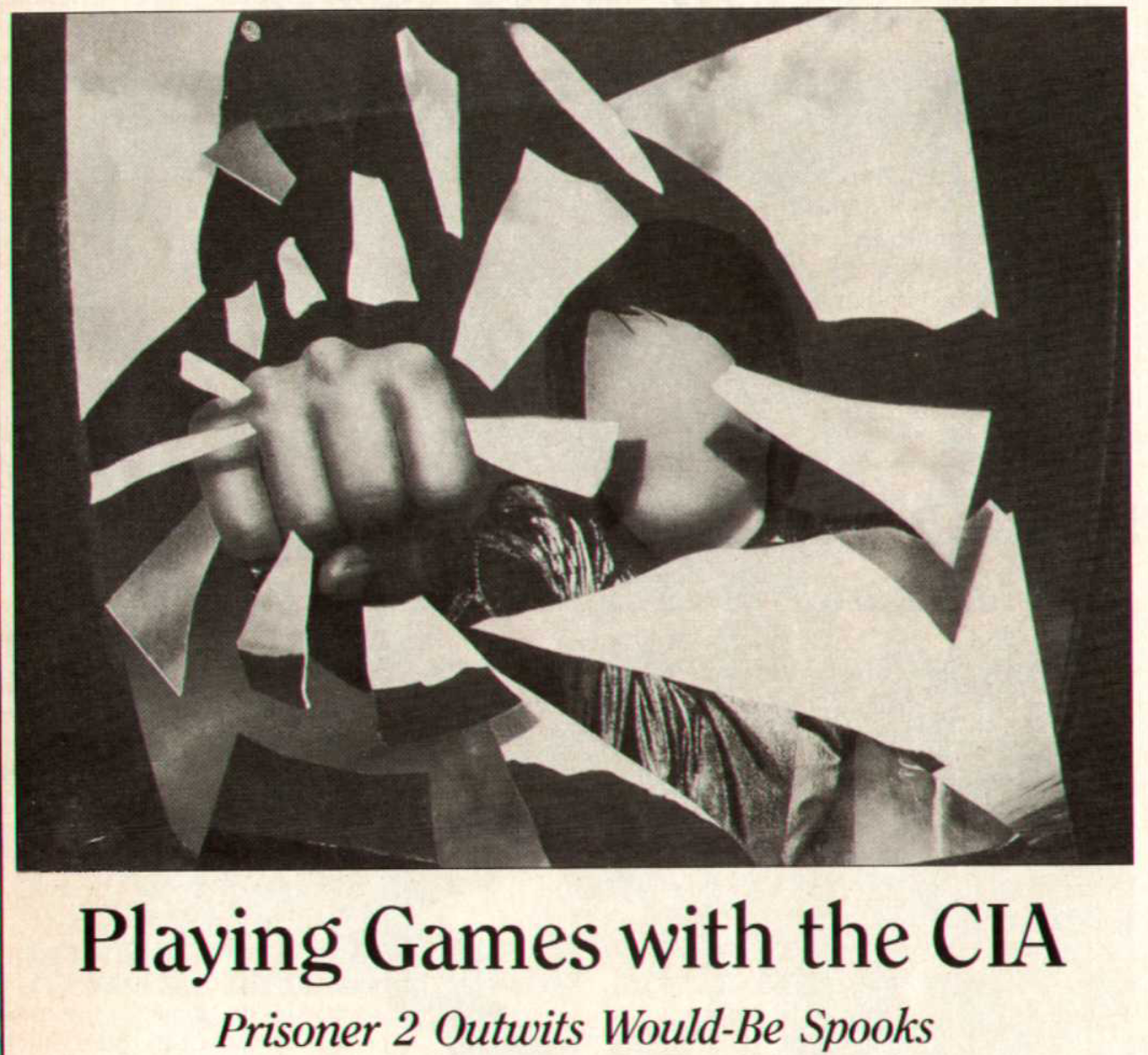
I would like to address one last thing. A lot of sources allege that this game (well, more specifically Prisoner 2) was used to train special agents in the Central Intelligence Agency. I decided to do a little digging. I traced this claim back to Wikipedia, where on a talk page someone claimed that the origin of the claim was an issue of Atari Power from 1983. This allegation made it’s way into the references of the page, without a link to the magazine itself. So then I went hunting for it. And lo and behold I found it, with the article in question on page 18 of the pdf.  (A sidebar here to point out the extremely interesting article “The Revival of The Fine Art of Letter Writing” on page 14, where the author indicates that there are now companies that will print out the email you wish to send to a friend and then mail it to them as a physical letter, as well as the article on page 19 that seems prescient for today: “Electronic University Goes On-Line”. ) The article makes note of the CIA reference, of course, talking about how the CIA uses it to either screen applicants or to train them in terrorist handling techniques. But the much more interesting part of the article is a random line, buried somewhere in the middle. “We also learned that Prisoner 2 has been used in the psychiatric field to treat patients suffering from paranoia.” What?! From my experience with The Prisoner it might just be enough to give me paranoia, which makes it all the more interesting that some intrepid psychiatrist somewhere saw fit to throw it at some of his patients to see if it helped. I was unable to find out more about this, sadly, at least not online. And so that story probably lives and dies in that sentence. Alas.


Shorter post this week, but have you played The Prisoner, or do you have any thoughts on it? Pick up the red phone and send us a message on Twitter or Facebook to let us know.

Posted by admin in Blog, 0 comments

332: Smoking Candy Corn (Children of Earth: Day Five)

Halloween can’t come soon enough.

So the children of earth are saved and the day is mine once more. We only had to sacrifice one kid rather than the 10% that the 456 requested, but the 456 are off gallivanting somewhere else. They have technology to do almost anything but replicate this weird chemical? I dunno. It’s Children of Earth: Day Five, written by Russell T. Davies and aired on July 10, 2009.


Show-notes:


1:01: It was Family Guy that did the Super Man 4 bit.
18:14: It’s not our latest post anymore, but here’s the post I was talking about: Children of Earth and the “First Contact” Archetype
1:11:17: It’s shallow focus.
1:19:40: It was Playing in the Dark by Toni Morrison. I think the link is just an excerpt of it.

Torchwood © The BBC
Any other references belong to their respective owners, no copyright infringement is intended by this podcast.
The Torchwood title music was originally composed by Murray Gold. The version used in this episode was arranged by Murray Gold.

Subscribe on Apple Podcasts!
Subscribe on Google Play!
Subscribe on Spotify!
Check us out on Facebook!
Check us out on YouTube!
Check us out on Twitter!


Posted by admin in Trust Your Doctor, 0 comments

331: Nickelodeon Slime (Children of Earth: Day Four)

I love slime!

Children of Earth is rapidly coming to a close. Which means we’re going to finally move on to the final season of Torchwood which means oh god we’re running out of content. What are we gonna do?! Maybe the 456 should take us instead, that way we can stop making podcasts. It’s Children of Earth: Day Four, written by John Fay and aired on July 9, 2009.


Show-notes:


1:50: Here’s the Ianto page on the TARDIS wiki.
8:06: Check out Inevitable: A Classic Sci-Fi Podcast, our classic sci-fi podcast. Here’s our first Sapphire and Steel episode.
25:52: Here’s a frickin weird ad about Nickelodeon slime as an example.
28:26: Here’s what the Aggro Crag looked like.
29:05: Check out our first Children of the Stones episode on Inevitable: A Classic Sci-Fi Podcast.
38:25: This guy
1:10:26: I didn’t look into it too much, but MySpace is kinda just dedicated to like media news and stuff nowadays it looks like.

Torchwood © The BBC
Any other references belong to their respective owners, no copyright infringement is intended by this podcast.
The Torchwood title music was originally composed by Murray Gold. The version used in this episode was arranged by Murray Gold.

Subscribe on Apple Podcasts!
Subscribe on Google Play!
Subscribe on Spotify!
Check us out on Facebook!
Check us out on YouTube!
Check us out on Twitter!


Posted by admin in Trust Your Doctor, 0 comments